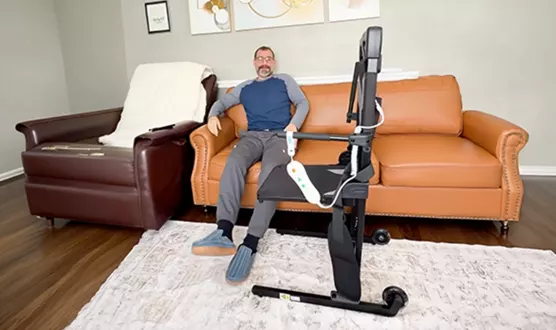
Floor Lift Chairs: How to Help Seniors Get Up After a Fall
20/08/2026
If you or a loved one is struggling with bathroom safety, you've probably come across two main options: bath lift chairs and shower chairs. Both are designed to make bathing safer — but they solve very different problems.
Choosing the wrong one means either spending money on features you don't need, or worse, ending up with a device that doesn't actually address the safety issue at hand.
Here's a clear, practical breakdown to help you decide.
A shower chair gives you a stable place to sit while you shower. A bath lift chair powers you in and out of a bathtub.
That's the fundamental distinction. One is about stability. The other is about mobility.
A shower chair is a simple, often non-electric seat that sits inside the shower or tub. It has rubber-tipped feet for grip, usually a backrest or armrests for support, and drainage holes so water doesn't pool on the seat.
It doesn't lift. It doesn't lower. It simply lets you sit safely while you bathe.
Key characteristics:
Best for people who:
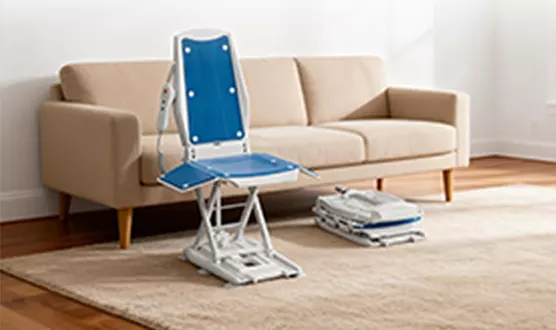
A bath lift chair is a powered device that lowers you into a bathtub and raises you back up using an electric motor. It sits inside the tub, secured by suction cups, and is operated with a simple waterproof remote — typically just up, down, and pause buttons.
Key characteristics:
Best for people who:
| Feature | Shower Chair | Bath Lift Chair |
|---|---|---|
| Primary function | Seated showering | Powered tub entry/exit |
| Power source | None | Rechargeable battery |
| Lifting capability | No | Yes — motorized raise/lower |
| Typical price | 30–150 | 400–800 |
| Portability | Excellent — lightweight, grab-and-go | Moderate — foldable but heavier |
| Installation | None — just place it | Suction cup placement in tub |
| Bathtub required? | No — works in any shower | Yes — designed for tub use |
| Reclining feature | Rarely | Yes — most quality models |
| Floor lift function | No | Yes — many models double as floor lifts |
| Maintenance | Almost none | Battery charging, occasional cleaning |
| Independence level | Moderate — you still need to get in/out | High — handles the hardest part for you |
Rather than thinking about which product is "better," think about which problem you're actually solving.
This isn't as extravagant as it sounds. Many families find that having both options provides the most flexibility:
A shower chair is the clear winner on price — quality models start around 50.Abathliftchairrequiresalargerinvestment,typically400-$800 for a reliable electric model.
But consider the cost of the alternative. A single fall-related hospital visit averages over $30,000 in the United States. A hip fracture from a bathroom fall can lead to months of rehabilitation, loss of independence, and in some cases, the need for long-term care placement.
In that context, even the most premium bath lift chair is a fraction of the cost of one preventable accident.
This isn't a competition between two products. It's about matching the right tool to the right problem.
If you feel unsteady but can manage getting in and out of the tub, start with a shower chair. It's affordable, simple, and immediately useful.
If the real challenge is the physical act of lowering into and rising from the bathtub, a bath lift chair is the answer. It handles the hardest, most dangerous part of the process and gives back something invaluable: the ability to bathe safely and independently.
And if you're not sure? Think about where you — or your loved one — feels most at risk. Is it standing in the shower? Or is it that moment of getting down into the tub and back up again? The answer to that question is your answer to which product you need.